PORTRAITS
by Maham Insha
Naanu’s silk saari, lime green
Unwashed hair, a sliver of silver curved in and out of my nose
A stick and poke tattoo of a star, unfinished, gap filled but darker than it was before
A cluttered dining table with a glass jar of coconut cookies and a glass jar of garlic paste,
Green leaves sprouting out of a large glass bowl
The smell of makhni handi lingering in the air, a dirty mirror
The sheen of silver glitter layered over chocolate brown eyeliner, lining my lower lids
Done so because I want to look meaner, but also still true to myself.
My anthropology class at university lets me be curious about observation without feeling guilt. It gave me a discipline that allowed me to poke and prod and justify that poking and prodding. Not that I have delved into anthropological work since then. I did however decide that I want to poke and prod at different artist residencies and communes around the world one day. There was this particular satanic artist’s commune that caught my eye, somewhere in the US, unsurprisingly.
I digress.
The class gave me a lens through which I could continue asking people about their life stories in order to be able to analyze them; I think this lets me feel like I’m building up to something substantial and I’m not just being nosey. I like creating such explanations and stories in my head; perhaps these collections will become part of significant research in understanding human behaviour and identity. Perhaps extremely qualitative, biased data is valuable. These are fun games to play when sifting through profiles you develop of the different people you meet.
Through years of ‘observational work’ I have learnt that there are many ways of accumulating information about people. Just as historians dig around for different sources: books to letters, jewellery to toys, I can, yes, grab someone by the hand and directly ask them to fill me in, like their vessel for information for stories and secrets. I can also notice their presence in the sort of clothes and makeup they like to wear, the kind of stones they like to adorn themselves with (boys AND girls), the kind of tattoos they have chosen to mark themselves with, the insides of their everyday bags, the things in their rooms that they decide to surround themselves with… and the list goes on. It’s fascinating for me, because I do believe that we use tools available at our disposal to create identities for ourselves, but that we also create identities through behaviour that we aren’t consciously keeping a check on. These identities are continuously shifting, creating, transcending, never breaking down because character is character, and its richness doesn’t have to do with moral behaviour or lack thereof. An incestuous football player with a buzz cut may be ‘bad’ for groping his younger brother every night but the complexity of his self is still interesting to observe and we don’t need to feel bad about it because we are just observing from the outside. That’s how anthropology is kind of fucked, but also brilliant. We don’t have our moral compass with us along with the rest of our tool kit.
Hence, driving home the point that our identities are continuously transforming, and never really breaking down.
I have observed for years, and I continue observing others with a brightened sense of sight, but it is not only others that I observe anymore. This wonderfully weird thing called the ‘Anthropology of the Self’ where one basically gets to observe oneself against different cultural contexts and incidents over time, opened me up to a new sort of documentation that I seem to engage in on a regular basis. In light of what I said earlier about using different sources to learn and unlearn about people, I take portraits of myself to capture myself in a certain position at a certain point in my life. I take them from my camera and grasp the me in that moment, and then use those aforementioned observational skills to write and further document what I see in that portrait. These portraits help me document and learn more about myself and the evolution of that transcendental identity that can shift in weeks or in minutes. When I recognize any shift, I stop, I grab my camera and ‘Click!’, a moment in my personal history is recorded, and a new source for my ‘anthropological’ work enters this world.
The portrait at the beginning of this essay was captured and transcribed on the hot, stuffy night of 9th August, 2019, which was very, very recent, no matter when this essay actually comes into your hands to read. It marks a period of adjustment, where a girl is trying to cope with heartbreak and a sense of loss, so she changes up her appearance with a homemade tattoo and a nose ring, and lets her mind float and be distracted which is marked through her want to try on old saaris. Her surroundings are messy and unlike her (which can be seen in contrast to earlier portraits) which also indicates her floating, unfocused self.
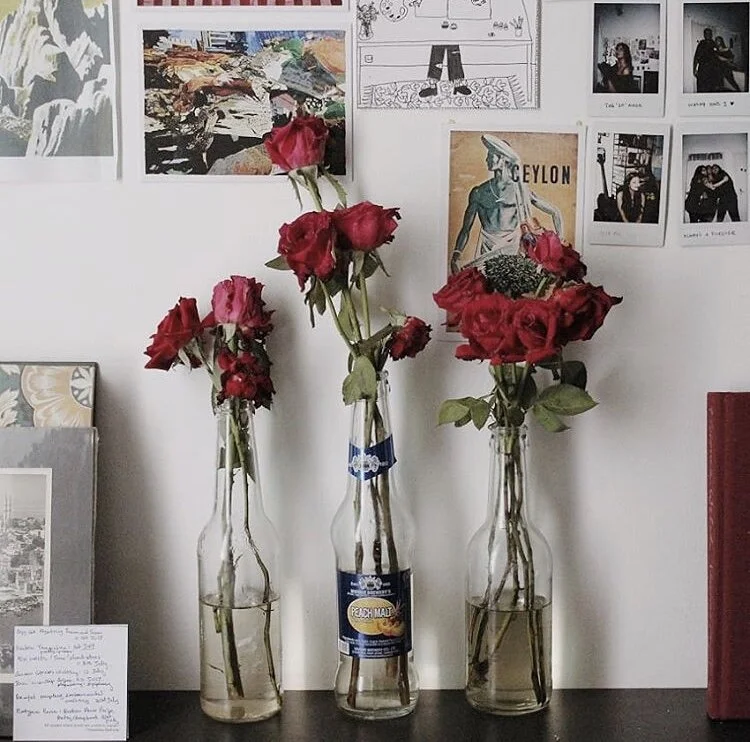
Portraits do not necessarily have to contain the face of the subject. Here is a portrait of the console at the foot of my bed on Tuesday, 3rd August, 2019:
A wilting red rose in an old malt bottle, bought to remind myself of my independence,
Mama’s borrowed purple amethyst, sparkling with its magic even in the dark,
An oil burner at work, and two oil bottles accompanying it:
Scent 1: Extracts from the banyan trees in Thailand
Scent 2: Labelled Dharamantra, smells like liquid sunshine,
Four stones picked from a Sri Lankan beach,
A copy of Florence’s ‘Strange Magic’ in velvet plum,
A South Asian cookbook, a gift from Mama
A little glowing moon, a gift from my younger brother.
The above portrait is a breakdown of the items I love having around me, love waking up to and going to sleep looking at. They represent my methods of self-care (the oils, the flower, the amethyst borrowed for its energy while my mother has been away and I have been sad), and in turn, my identity.
I have also collected strings of portraits from a single day and the events that took place in it. Here’s an example from 1st September, 2019 (As you can see through the dates, I take these quite frequently):
The old afghan carpet stolen from the box room,
Fuschia lights blasting over our heads at the laser room at the Creative Karachi festival, the artist in his fedora and silk vest twiddling around with his tech gear,
Juicy melons cut up in squares, trays of daal and bhindi, a bowl of dahi and soft, garam chapattis at Deena’s house,
A tired face, an obnoxious orange, oversized T-shirt and a piece of rose quartz hanging from my neck on a black string,
A messy kitchen counter, colorful with yellows, greens and reds from the peaches, lettuce leaves and tomatoes I was cutting up for meal prep,
A plate with two tortilla wraps, filled with vegetables and scrambled eggs, garnished with paprika,
Plants in my balcony shivering, quaking, dancing and indulging in the rain.
And this portrait breaks down accumulated memories over a couple of days. It shows me what dietary decisions I was making, what activities I was partaking in (plant watching in the balcony) and what way I decided to present myself to— well— myself at home. It shows me what I remember, what I deemed important to capture. It spreads out in front of me a train of thought, and a moment in which my identity was shifting. Because it always is. And this is what my strange photographs are for. Portraits of the self, to understand the self, and to observe the self through its entire life line.
Maham Insha is currently a Social Development and Policy student at Habib University. She writes, composes songs and hosts intimate and experimental music, poetry and art gatherings at her home under the project name 'Things Mana Hosts'. She is interested in anthropological work to do with studying communes, residencies and subcultures; she draws botanical illustrations and loves working on community based projects.
visual by maham insha.